Professional Agri-Forestry Industry Insights | Global Intelligence Leader

How invoice errors delay customs clearance for horticultural products





Fresh produce or cut flowers can arrive under refrigeration and still miss their delivery window because the commercial invoice does not support the import declaration. A vague description, incorrect currency, or unexplained quantity difference can prompt customs to request clarification, reassess the declaration, or require an amendment before release. While documents are being corrected, the shipment continues using its remaining shelf life.
The immediate task is to identify which invoice field is blocking clearance, compare it with the physical shipment and supporting records, and submit a controlled correction through the importer or customs broker. For horticulture products customs clearance, the invoice must accurately explain what is being traded, its quantity, value, and relevant origin details. It must also be consistent with the packing list and applicable plant-health documents, without assuming that customs release and phytosanitary clearance are the same approval.
Where an invoice error interrupts release
The commercial invoice supplies information used to prepare or verify the customs declaration. Authorities may use it to assess classification, customs value, duties, taxes, origin claims, and the identity of the parties. An error can therefore affect more than one declaration field.
Before arrival, a broker may stop filing because essential information is missing. After filing, a discrepancy may generate a documentary query or require an amendment. During examination, a mismatch between the goods and their description may lead to further checks. These are different situations: sending a revised invoice to the carrier will not necessarily correct a declaration already lodged with customs.
Plant-health clearance is a separate control. Where a phytosanitary certificate or import permit is required, correcting the invoice does not resolve an invalid certificate, a prohibited commodity, or a failed inspection. First establish whether the hold concerns customs documentation, plant-health requirements, another border agency, or several controls together.
Invoice fields that deserve the closest attention
Descriptions that conceal the actual product
Terms such as “horticultural goods,” “flowers,” or “fresh produce” may be too broad to support classification or identify applicable import conditions. A mixed shipment described as one generic line is particularly difficult to reconcile when its components have different tariff treatments or plant-health requirements.
Use separate lines for distinct commodities. State the common product name and its condition: fresh, dried, frozen, rooted, unrooted, or otherwise prepared, as applicable. Include botanical names, variety information, growing-medium details, or intended use where required to distinguish the goods or meet destination requirements. A rooted ornamental plant and a cut flower should not be treated as interchangeable descriptions.
A tariff code on the invoice does not compensate for an unclear description. The broker should verify the destination classification against the actual goods; copying a code from a previous shipment can repeat an earlier mistake.
Quantities that use incompatible units
Horticultural shipments commonly involve cartons, trays, bunches, stems, pots, and kilograms. Different units are not automatically inconsistent, but their relationship must be clear. An invoice showing bunches and a packing list showing stems should provide enough detail to reconcile the totals.
Check whether the quantity represents sale units, inner packs, or outer cartons. Keep net product weight separate from gross shipping weight. Pallets, sleeves, water containers, and protective packaging can explain differences, but they should not be silently counted as product weight.
Values, currencies, and delivery terms that do not reconcile
A misplaced decimal, missing currency, or incorrect unit price can prevent the broker from establishing a defensible customs value. Recalculate each line and the invoice total. Confirm whether discounts, freight, insurance, and other charges are included, excluded, or separately stated.
Delivery terms help explain which costs the commercial price covers, but they do not determine customs value by themselves. State the agreed Incoterms rule and named place where applicable, then have the broker apply the destination’s valuation rules. Free samples and replacement goods may still require a declared customs value; “no charge” is not necessarily an acceptable valuation.
Origin and party details copied from an older shipment
The dispatch country is not necessarily the country of origin. Goods consolidated or repacked in another country do not automatically acquire that country’s origin. Mixed-origin consignments may require origin information at line level.
Check the seller, buyer, consignee, and importer details against the intended transaction and filing requirements. These parties need not all be the same entity, but their roles should be clear. An outdated address or incorrect importer identifier can prevent an otherwise accurate invoice from being used in the declaration.
Reconcile the documents without forcing them to be identical
Consistency means that the documents describe the same consignment and that differences can be explained. It does not mean every document must contain identical wording, quantities, or commercial information. A phytosanitary certificate serves a different purpose from an invoice and normally does not establish the transaction value.
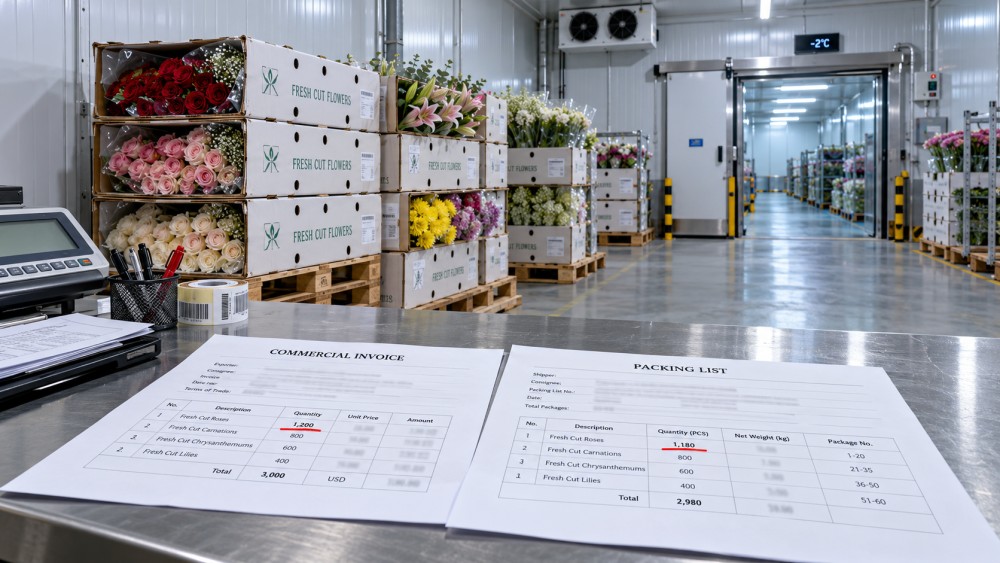
For example, a packing list may record outer cartons while the invoice records sale units. That is workable when carton contents and totals are traceable. A difference caused by rejected cartons before loading is more serious: the commercial records and any affected official documentation must reflect the actual consignment through the applicable correction procedure.
Do not edit a phytosanitary certificate to make it match a corrected invoice. Where official certification needs correction or replacement, contact the issuing plant-protection authority through the appropriate channel. The same principle applies to permits and other controlled documents.
When the shipment is already waiting: a correction sequence
- Obtain the exact hold reason. Ask the broker for the authority’s query, the disputed field, and the declaration reference. “Invoice problem” is too vague to act on. Confirm which approvals remain outstanding.
- Compare the filed version with the shipped goods. Collect the invoice used for filing, final packing list, transport document, relevant certificates or permits, and dispatch records. Check whether the problem is an invoice error, a declaration-entry error, or an actual loading discrepancy.
- Verify the correct information at its source. Confirm prices and currency against the agreed transaction, quantities against final packing records, and origin against reliable production or supplier records. Do not choose whichever figure makes the paperwork easiest to align.
- Issue a traceable correction. Follow the destination’s requirements for revised invoices, replacement documents, or supporting explanations. Clearly identify the affected invoice and revision so the broker can distinguish it from the superseded version.
- Confirm that the filing has been addressed. Ask whether an amendment, additional evidence, or another formal procedure is required. Obtain confirmation that the correction was submitted and whether further action is pending.
Keep the explanation factual: identify the original error, the corrected information, and its supporting record. Repeatedly sending revised PDFs without explaining the change can create uncertainty about which document represents the transaction.
A corrected invoice may resolve a simple typographical error. A change involving commodity identity, origin, value, or certificate scope can require broader review. Customs may request supporting evidence or inspect the goods; document replacement alone does not guarantee release.
Protect the cargo while the paperwork is corrected
Document work and cold-chain management should run in parallel. Ask the carrier or handling facility where the shipment is held, whether suitable temperature-controlled storage is available, and whether any examination will involve moving the goods out of refrigeration. Give handling instructions appropriate to the commodity rather than assuming all horticultural products require the same conditions.
Review temperature records and receiving specifications while the broker handles the declaration. A documentary delay does not prove that the cargo has deteriorated, and maintaining refrigeration does not guarantee acceptable arrival quality. Both elapsed time and actual handling conditions matter.
Notify the receiver when the clearance uncertainty affects delivery planning. Arrange revised transport only against a realistic release status, not the time the corrected invoice was emailed. Customs release, plant-health release, terminal availability, and carrier handover may each need confirmation before collection.
Build the invoice from the final packed shipment
The strongest preventive control is a reconciliation point after packing is finalized and before the declaration is submitted. An invoice prepared from an early order can remain wrong even when every calculation on it is correct. Substitutions, short shipments, rejected cartons, and packing changes must reach the person issuing the commercial documents.
Use a shared shipment record containing product identity, sale unit, packing conversion, quantity, net weight, origin, price, and currency. Where several systems are involved, assign responsibility for checking the exported data rather than assuming an automated transfer preserves its meaning.
- Before dispatch: reconcile the invoice with final packing records and check product descriptions against destination requirements.
- Before filing: have the broker review unfamiliar commodities, new origins, mixed consignments, and unusual valuation arrangements.
- After a late change: identify every affected document and notify the filer before the old information is submitted.
- At handover: distribute one controlled document set and retain the revision history.
Escalate differences that cannot be explained by packing conversions or a straightforward clerical correction. Uncertain origin, unsupported value, an incorrectly identified plant, or goods outside a permit’s scope require resolution with the responsible broker or authority, not cosmetic changes to the invoice. The practical test is whether the declared shipment can be supported by the actual goods and reliable records.
Got questions about this industry topic or seeking best practices for your business? Drop us a line below, and let the expert team at AgriTrade help you out.
We respect your privacy. Your information is strictly confidential.
Related News
- 00
0000-00
EU Issues Regulation Restricting Lead in Fishing Gear - 00
0000-00
Agriculture Ministry Calls for Strict Yellow River Fishing Bans and Greener Farming - 00
0000-00
Three Ministries Set Out University Admissions Plan for Rural Revitalization - 00
0000-00
Animal Health Policy News: Disease Reporting and Trade Updates - 00
0000-00
U.S. Food Manufacturing Safety Regulations: Key FDA Compliance Requirements
0000-00
Policy & Regulations Editorial Team
Weekly Insights
Stay ahead with our curated technology reports delivered every Monday.