Professional Agri-Forestry Industry Insights | Global Intelligence Leader

Are Eco-Agriculture Products Easier to Certify for Export Markets?





Export certification is rarely easier simply because a product is described as eco-friendly. Sustainable farming practices can improve market positioning, reduce certain compliance risks, and make a supplier more attractive to buyers, but they do not replace the technical requirements that govern cross-border trade.
For growers, processors, cooperatives, and exporters, the more useful question is not whether eco-agriculture products are easier to certify. It is whether the business already has the controls needed to prove what it claims, meet the destination market's mandatory rules, and maintain compliance after the first shipment.
That distinction matters. A farm may use fewer synthetic inputs, conserve water, protect soil, or adopt regenerative practices. These are commercially meaningful strengths. Yet an importing country may still focus first on pesticide residues, microbiological safety, phytosanitary documents, traceability records, labeling, packaging compliance, and border inspection procedures. In animal products and seafood, disease controls, veterinary drug residues, processing hygiene, cold-chain integrity, and approved-establishment requirements may be even more decisive.
Eco credentials can create an advantage, but they should be treated as an additional layer of evidence, not a shortcut through export regulation.
Why the assumption persists
The idea that sustainable products should be simpler to certify comes from a reasonable starting point. Products made with organic methods, reduced chemical inputs, verified responsible sourcing, recyclable packaging, or lower environmental impact often align with the direction of global food and agricultural markets. Importers, retailers, food-service operators, and consumers are asking more questions about how products are grown, processed, transported, and packaged.
In some categories, a recognized sustainability certification may indeed make buyer qualification more efficient. A buyer looking for organic grains, responsibly farmed seafood, traceable timber, or low-residue fresh produce may prefer suppliers that can present credible third-party documentation from the outset. This can reduce the time spent establishing basic trust, especially when the buyer has internal sourcing targets or retailer commitments.
But buyer qualification is not the same as market access. A certification valued by a retailer may have little effect on whether a shipment clears customs. Likewise, an environmental claim that works well in one market may be regulated differently, or carry less commercial value, in another.
The export process normally has two parallel tracks:
- Mandatory regulatory compliance, including food safety, plant and animal health, customs, labeling, and import documentation.
- Voluntary or commercial assurance, including organic, sustainable agriculture, ethical sourcing, carbon, biodiversity, animal welfare, or responsible packaging claims.
Confusing these tracks is one of the most common causes of weak export preparation. A supplier may invest heavily in a sustainability label while leaving gaps in lot-level traceability, residue testing, approved processing procedures, or destination-language labeling. The product can still face rejection, delay, relabeling costs, or a lost customer relationship.
Where eco practices can make certification more manageable
Environmental practices can improve export readiness when they are built into normal operating controls rather than added as a marketing statement. The benefit comes from discipline, documentation, and risk reduction.
For example, a producer that carefully records field applications, seed sources, fertilizer use, irrigation events, harvest dates, and storage conditions is usually better positioned to respond to traceability and residue inquiries. An organic operation that separates production lots, maintains supplier records, manages contamination risks, and undergoes periodic inspections may already have many of the administrative habits required by international buyers.
Similarly, a processor pursuing reduced waste or sustainable packaging may have reviewed its packaging materials, supplier declarations, migration risks, and recycling claims more closely than a business that treats packaging as a purely purchasing decision. That does not automatically prove compliance with food-contact rules in every destination, but it can make the compliance review more structured.
Eco-agriculture systems may also lower particular risks. Reduced reliance on certain agrochemicals can reduce the likelihood of residue exceedances, provided that the farm controls drift, water contamination, storage, and post-harvest treatment. Better soil management can strengthen crop consistency over time. Improved animal welfare and biosecurity practices may support herd health and antibiotic stewardship. Better water management in aquaculture can contribute to disease prevention and environmental performance.
However, lower risk is not zero risk. Export authorities and buyers generally require evidence, not assumptions about production methods.
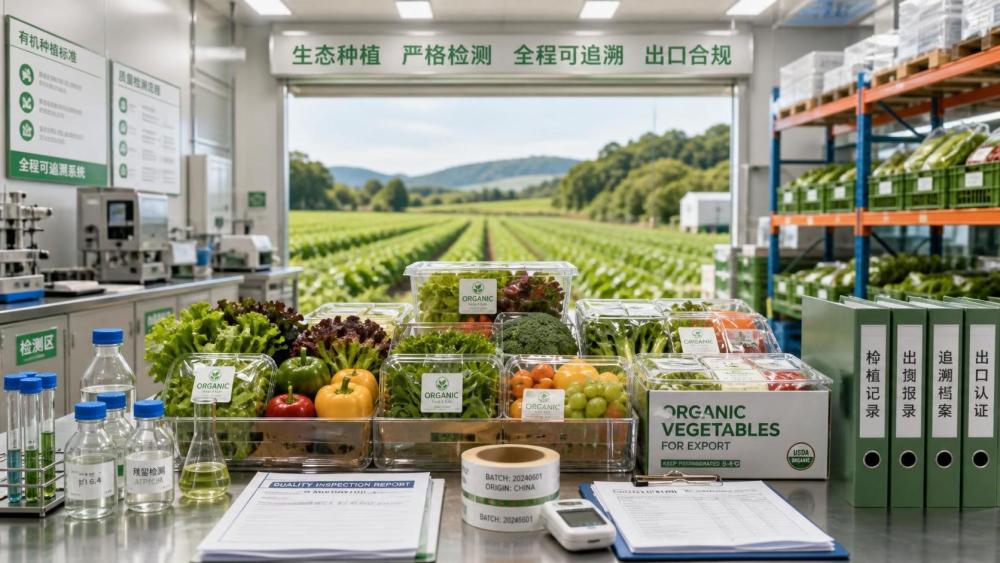
The real compliance test is destination-specific
Export certification becomes difficult when a business assumes that one certificate applies everywhere. Agricultural trade is shaped by destination-country rules, bilateral agreements, commodity-specific protocols, and the requirements of individual importers. The same product may face different thresholds, documents, inspection systems, and claim restrictions across markets.
A fresh fruit exporter may need phytosanitary certification, pest-management records, treatment evidence, packinghouse controls, and country-specific labeling. A processed food exporter may need to demonstrate compliant ingredients, allergen declarations, nutrition labeling, food-contact packaging safety, and facility hygiene controls. Seafood exporters may need catch documentation, health certificates, temperature records, species identification, and evidence related to illegal, unreported, and unregulated fishing controls where applicable.
For livestock-derived products, market access can depend on matters beyond the individual supplier's control. Disease status, national residue-monitoring programs, approved slaughter or processing establishments, veterinary certification arrangements, and temporary import restrictions can all determine whether a product is eligible for a market at all.
Environmental claims add another layer. Terms such as “organic,” “natural,” “carbon neutral,” “regenerative,” “pesticide-free,” “sustainably sourced,” and “biodegradable” may be subject to formal definitions, certification rules, substantiation expectations, or consumer-protection scrutiny. A claim accepted in a domestic market may need adjustment before it is used on export packaging or in overseas sales materials.
The practical lesson is straightforward: begin with the destination and product form, then map the required proof. Do not begin with the certificate already held and assume it determines market eligibility.
Traceability is often the dividing line
Many small and mid-sized agricultural suppliers have credible sustainable practices but struggle to convert them into export-ready documentation. The problem is not necessarily production quality. It is the inability to connect a finished shipment back to a specific farm, pond, vessel, field, livestock group, input batch, processing date, and packaging lot.
Traceability has become a core commercial issue because it links food safety, recall response, origin verification, sustainability claims, and buyer confidence. When a customer asks whether a shipment contains a specific lot, whether a prohibited input was used, or where a packaging material came from, the exporter needs a timely and consistent answer.
For eco-agriculture products, traceability also protects the claim itself. If organic and conventional material are handled in the same facility, segregation must be demonstrable. If a product is marketed as deforestation-free, responsibly sourced, or farm-specific, the supply chain needs supporting records. If a buyer requests lower-carbon sourcing information, the supplier must understand what data is available and what methodology is being requested.
The detail required will vary by market and commodity. The important point is that a sustainability narrative without operational records is fragile. It may help start a sales conversation, but it will not withstand a buyer audit, border inquiry, or complaint investigation.
Certification can create new obligations, not only new access
Businesses sometimes see certification as a one-time hurdle: complete an audit, obtain a document, and use it to enter export markets. In practice, certification usually creates an ongoing management responsibility.
There may be annual audits, unannounced inspections, residue sampling, chain-of-custody checks, corrective-action deadlines, transaction certificates, logo-use rules, supplier approval requirements, and changes to standards or destination regulations. Expanding from raw material exports to processed goods can also change the compliance burden because ingredients, additives, labels, packaging, and manufacturing controls become more important.
This is particularly relevant for businesses moving quickly into premium export channels. A buyer may initially accept a certificate as part of supplier onboarding, then request additional social, environmental, quality, or food safety evidence before increasing volumes. The exporter needs to evaluate whether its quality team, farm management system, and document control process can support that progression.
Costs should be assessed broadly. Audit fees are visible, but internal recordkeeping, staff training, laboratory testing, facility upgrades, translated labeling, supplier monitoring, certification renewals, and delayed shipments can have a larger commercial effect. For smaller producers, group certification, cooperative systems, or shared technical support may be more realistic than each farm building a separate compliance structure.
Common claims that need closer scrutiny
Several statements appear often in trade discussions but need qualification.
“Organic means the product will pass residue testing.”
Not necessarily. Organic systems may restrict many inputs, but residue findings can result from historical soil contamination, spray drift, contaminated water, storage issues, mixing during transport, or fraud elsewhere in the supply chain. A strong residue-control plan remains necessary.
“Sustainable packaging makes export compliance easier.”
Only when the material is suitable for the product and accepted under the destination market's relevant rules. Recycled, compostable, or lightweight packaging can introduce questions about food contact, barrier performance, shelf life, recycling infrastructure, labeling, and product protection. Packaging failure can create food waste and quality losses that undermine the environmental objective.
“A global certificate guarantees access to every market.”
Certificates can be widely recognized, but legal import conditions remain market-specific. Customs, sanitary, phytosanitary, and labeling requirements may still apply independently. Exporters should verify recognition, scope, and document format for each destination.
“Buyers will always pay more for eco-certified goods.”
Premiums depend on category, supply conditions, product quality, origin, volume, buyer strategy, and consumer demand. In some markets, environmental compliance is becoming a condition of participation rather than a reason for a price premium. A supplier should model the certification cost against realistic sales opportunities, not against a general expectation of higher margins.
A practical decision framework before pursuing certification
Before choosing a certification route, an exporter should first define the commercial opportunity precisely. Which country is being targeted? Is the product fresh, frozen, dried, processed, or bulk? Is the buyer a retailer, distributor, ingredient manufacturer, food-service company, or online seller? Are the requirements legally mandatory, buyer-driven, or both?
From there, the business can compare the current production system with the evidence required. This assessment should include farm records, input controls, supplier qualification, water and soil management, testing plans, storage, processing, lot coding, logistics, labels, and complaint or recall procedures. Gaps should be ranked by their effect on market access rather than by how visible they appear in promotional materials.
For many suppliers, the first commercial step is not obtaining every possible sustainability certificate. It is establishing a reliable baseline: food safety controls, traceable lots, compliant labels, verified destination requirements, and a document package that can be produced quickly. Sustainability certification can then be selected where it matches buyer demand and creates a defensible commercial advantage.
Exporters should also ask buyers direct questions early. Which certifications are accepted? Is an equivalent standard acceptable? Is a chain-of-custody certificate required? What laboratory tests are expected? Are there destination-specific packaging or environmental-claim rules? What documentation must accompany each shipment? These questions are more useful than relying on broad descriptions of “green market access.”
The direction of travel favors proof, not slogans
Environmental expectations in agriculture are likely to remain important as markets respond to climate pressure, resource constraints, food-safety concerns, supply-chain transparency, and changing retailer requirements. At the same time, regulators and buyers are becoming more cautious about unsupported claims. The commercial value of eco-agriculture products will increasingly depend on whether suppliers can connect environmental performance to credible records, consistent quality, and destination-market compliance.
That is why eco-agriculture products are not automatically easier to certify for export markets. They can be easier to position, easier to discuss with sustainability-focused buyers, and sometimes better prepared for certain assurance systems. But export readiness ultimately rests on a less glamorous foundation: accurate documentation, controlled production, traceable supply chains, valid testing, compliant packaging and labels, and a clear understanding of the market being entered.
For businesses following agricultural trade developments, the most useful signal is not the number of green claims appearing on products. It is whether those claims are supported by systems that can survive an audit, a border inspection, and the operational demands of repeat international business.
Related News
- 00
0000-00
Seed Approval Timelines: Key Regulatory Stages Before Commercial Sale - 00
0000-00
Greenhouse Agriculture Regulation News: What Growers Need to Track in 2026 - 00
0000-00
How China’s Fishery Policy Shapes Aquaculture Compliance and Market Access - 00
0000-00
How Sustainable Food Packaging Policies Affect Material Choices and Compliance - 00
0000-00
Poultry Farming Policy: Key Compliance Areas for Farm Operators
Policy & Regulations Editorial Team
Weekly Insights
Stay ahead with our curated technology reports delivered every Monday.