Professional Agri-Forestry Industry Insights | Global Intelligence Leader

Why Are Seafood Trade Clearance Delays Increasing in 2026?





Seafood clearance has become a commercial issue, not just a border formality
For much of the seafood trade, customs and sanitary clearance were once treated as a predictable final step: documents were submitted, containers were inspected when required, and product moved into cold storage or onward distribution. That assumption is becoming less reliable in 2026. Importers, exporters, processors, and foodservice buyers are seeing more shipments held for document review, laboratory testing, traceability checks, identity verification, or port-side congestion.
The immediate question is not simply why a particular consignment was delayed. Businesses need to know whether the delay is an isolated operational failure, a recurring route-level risk, or evidence that their sourcing and compliance model needs to change. In seafood, a few additional days can alter product quality, increase reefer charges, create missed production slots, and weaken customer confidence. For live, fresh, chilled, and high-value frozen products, the commercial effects may be disproportionate to the original administrative issue.
Clearance delays in 2026 are increasing because several systems are changing at the same time. Food controls are becoming more risk-based and data-intensive. Traceability expectations are expanding. Customs platforms are becoming digital but not always interoperable. Authorities face staffing and laboratory capacity limits. And geopolitical, disease-related, and environmental concerns are making seafood imports more sensitive than many other food categories.
More control points are being applied to the same shipment
A seafood consignment may need to satisfy multiple authorities and rule sets before it can be released. Customs declarations, catch documentation, health certificates, veterinary or sanitary certificates, origin records, import permits, labeling information, packaging compliance, temperature records, and product-specific restrictions may all be relevant. The exact requirements differ by market and species, but the direction is broadly consistent: regulators expect a clearer chain of evidence from harvest or farm through processing, export, transport, and import.
That does not mean every shipment now faces a full physical inspection. Many agencies use risk profiling to target certain products, origins, suppliers, species, seasons, or declared values. But risk profiling can itself create uncertainty. A business with an otherwise clean record can be selected because of a new alert, a change in country risk classification, inconsistency in submitted data, a broader enforcement campaign, or a concern linked to a similar product line.
Seafood is particularly exposed because the product is biologically sensitive and commercially complex. A shipment may include multiple species, processing forms, production lots, and catch or farm origins. Product descriptions that were adequate for a commercial invoice may not be detailed enough for a border authority trying to verify species identity, production method, harvest area, or tariff classification.
In practice, clearance speed increasingly depends on the consistency of the full information set, not on whether a single certificate appears valid in isolation.
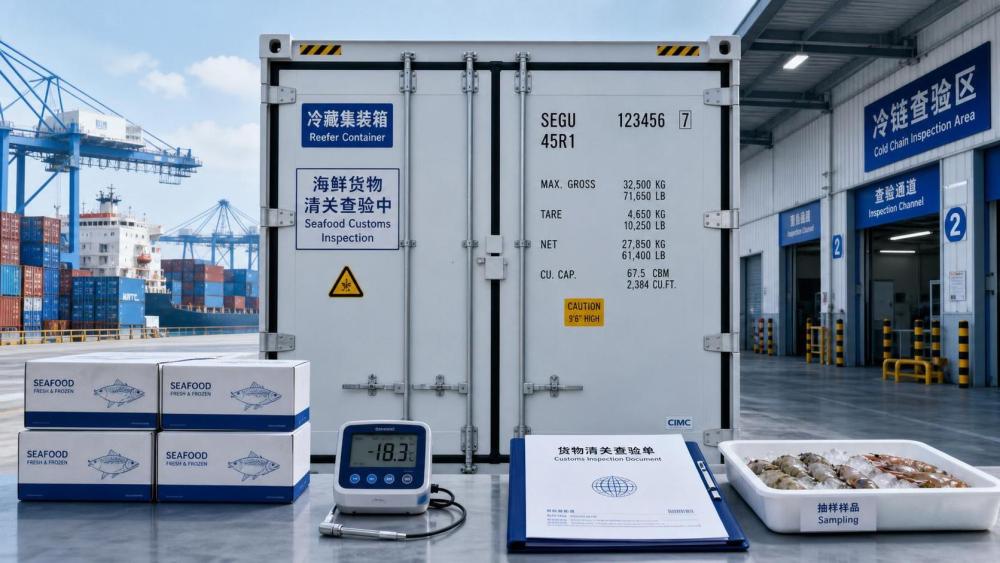
Traceability rules are moving from documentation to verification
Traceability has long been important in seafood, especially for food safety, illegal, unreported and unregulated fishing concerns, and recall management. What is changing is the level of verification expected at import. Regulators and buyers are placing more emphasis on whether documents connect logically across the supply chain. A catch certificate, processing statement, health certificate, bill of lading, invoice, carton marking, and customs declaration should tell a coherent story.
This creates a common problem for complex supply chains. A processor may combine raw material from several vessels, farms, suppliers, or production dates. The final exported product may be packed under one commercial SKU, while the underlying documentation contains multiple source references. This is not automatically non-compliant, but it requires strong lot control and accurate document mapping. Where the mapping is unclear, authorities may hold the shipment while they request clarification from the importer, exporter, certifying body, or overseas competent authority.
Traceability scrutiny is also not limited to wild-caught fish. Farmed seafood can face questions about farm registration, feed controls, veterinary drug records, disease status, harvest dates, processing conditions, and country-of-origin statements. Shrimp, salmon, bivalves, tuna, cephalopods, whitefish, and value-added seafood each bring different risk signals and documentation expectations.
A frequent mistaken assumption is that a recognized certification or a familiar supplier relationship will prevent delays. Certifications and long-term supplier records can support due diligence, but they do not replace import documentation, government-issued evidence where required, or the receiving market's own inspection authority.
Digital customs systems can shorten routine clearance while exposing weak data
Digitalization is often presented as a solution to border friction. It can be, particularly when declarations are pre-filed, certificates are verifiable electronically, and port systems share information with customs, inspection agencies, terminal operators, and brokers. For routine consignments with clean, standardized data, digital systems may reduce manual handling and help identify problems before arrival.
However, the transition period can produce more exceptions rather than fewer. A document can be technically complete yet fail validation because a company name, establishment number, species code, date format, unit of measure, or origin reference does not match another record. Data may be correct in business terms but incompatible with the receiving system's required fields. Manual correction becomes slower when a shipment has already been flagged in an automated workflow.
Importers should distinguish between digitized paperwork and genuinely integrated compliance data. Sending PDFs through an online portal is not the same as maintaining a structured dataset that can reconcile purchase orders, production lots, certificates, packing lists, container numbers, and declarations. The latter is more demanding, but it reduces the chance that a broker, exporter, and importer submit conflicting information under time pressure.
The exposure is highest where parties rely on spreadsheet handoffs, repeated manual rekeying, translated product descriptions, or last-minute amendments. These practices may have worked when authorities reviewed fewer data points, but they are increasingly fragile in a digital clearance environment.
Inspection capacity is not keeping pace with inspection complexity
Longer delays do not always signal stricter policy. They may reflect a capacity mismatch. Inspection agencies, laboratories, ports, terminals, and customs offices must deal with rising trade volumes, a broader set of compliance checks, staff turnover, technical system upgrades, and episodic disruptions. When a shipment is selected for sampling or laboratory analysis, the release timeline can depend on factors outside the control of the importer or broker.
Laboratory testing is especially important for seafood because controls may address microbiological hazards, residues, contaminants, histamine risks, species substitution, sulfites, additives, or other market-specific concerns. Testing requirements and trigger thresholds differ by jurisdiction. Results, retesting procedures, and administrative release practices should therefore be confirmed for the intended destination rather than assumed from another market.
Capacity constraints can compound at busy ports. A container may be available for inspection only after terminal handling, appointment scheduling, document acceptance, and agency availability align. Refrigerated containers need power while they wait. Demurrage, detention, storage, plug-in, examination, and transport rescheduling costs can accumulate even where the product ultimately passes inspection.
Policy changes are arriving through several channels
Seafood trade is affected by more than traditional customs rules. Import conditions may shift because of food safety concerns, aquatic animal health measures, fisheries management, sanctions, anti-fraud enforcement, sustainability rules, labeling requirements, or bilateral trade disputes. A policy change may be published well before it is consistently understood by suppliers, brokers, and logistics partners. In other cases, enforcement intensity changes before the market has a clear sense of how frequently products will be stopped.
This matters because many businesses monitor only the tariff and duty side of import compliance. For seafood, the more operationally significant risk may sit in sanitary, veterinary, fisheries, origin, or traceability requirements. A product can have an acceptable tariff treatment and still be delayed or refused because the accompanying evidence does not meet a non-tariff requirement.
There is also a difference between a rule being announced and a rule being operationally ready. New digital certificate systems, revised data fields, or updated import procedures often require interpretation at multiple points: the exporter, local certifying authority, freight forwarder, customs broker, importer of record, and destination inspector. During this transition, conservative authorities may request additional evidence rather than accept an unfamiliar format.
Companies should avoid treating public announcements as the final operating instruction. The useful question is: what evidence will the border authority actually expect for our species, origin, processing form, and route on the date the shipment arrives?
The commercial impact depends on product type and operating model
Not every seafood business experiences delay in the same way. Frozen commodity products may have more buffer than fresh fillets intended for retail promotions, but they can still incur substantial container and storage costs. Fresh and chilled seafood has narrower quality and shelf-life tolerance. Live products can face welfare, mortality, and handling risks. Processors depending on imported raw material may have to idle labor, delay production runs, or substitute supply at a higher cost.
For buyers, the important distinction is between a delay that can be absorbed through inventory planning and a delay that changes the economics of the contract. A low-margin shipment with a two-day buffer is not equivalent to a premium, customer-specific order requiring delivery on a fixed date.
- Retail and foodservice buyers should examine shelf-life, promotion dates, substitute availability, and claim responsibility for delayed delivery.
- Processors should assess raw-material buffers, approved alternative suppliers, cold-store capacity, and the effect of a hold on production scheduling.
- Importers and distributors should model total landed cost, including inspection-related charges rather than duty and freight alone.
- Exporters should review whether their document preparation can meet destination-specific timelines without relying on last-minute corrections.
- Trading companies should clarify which party controls document submission, broker communication, release decisions, and costs if a shipment is selected for inspection.
What businesses should review before the next shipment
The practical response is not to assume that every shipment requires more paperwork. It is to identify which evidence is material to the route and make it available earlier. A disciplined pre-shipment review should compare the commercial documents, regulatory certificates, carton marks, container information, and customs data before the cargo reaches the port.
Start with the product identity. Are scientific and commercial names used consistently? Is the processing form described accurately? Do quantity, net weight, gross weight, carton count, and lot references reconcile across all documents? Are the producer, processor, exporter, and establishment approvals stated in the format required by the destination market?
Then examine ownership of the process. A supplier may believe the freight forwarder will resolve a discrepancy, while the importer assumes the supplier has already confirmed compliance. That gap becomes expensive after arrival. One named person or team should have authority to reconcile exceptions, obtain source documents, and communicate with the broker before the shipment is placed on hold.
It is also worth treating clearance performance as a supplier-management metric. Buyers commonly assess price, quality, capacity, and delivery reliability. In 2026, they should also ask how often a supplier's shipments require document amendments, how quickly the supplier can provide traceability evidence, whether approved facilities and certificate workflows are current, and how the supplier responds to a regulatory query outside local business hours.
Build buffers around uncertainty, not around average transit time
Many supply plans are built around the average ocean transit and normal port release cycle. That is no longer enough for sensitive seafood flows. Planning should include a realistic exception scenario: a document query, physical examination, sample collection, laboratory wait, or delayed inspection booking. The appropriate buffer will vary by product and route, but it should be based on the consequences of a hold, not merely historical average clearance time.
This does not require holding excessive inventory everywhere. It may involve diversifying entry ports, qualifying a second origin, maintaining limited safety stock for critical SKUs, reserving cold storage capacity, or adjusting contract delivery windows. For some buyers, the more important step is separating high-risk and time-critical products from routine consolidated shipments, so one documentation issue does not affect an entire mixed load.
Seafood trade clearance delays in 2026 are unlikely to be solved by a single technology platform, a new broker, or one additional certificate. The underlying change is that border authorities are asking the supply chain to prove more, connect information more precisely, and respond more quickly when something does not match. Businesses that understand clearance as part of procurement, quality assurance, and logistics planning will be better positioned than those that still treat it as paperwork completed after the commercial deal is done.
Related News
- 00
0000-00
Phyto Registration for Agricultural Exports: Documents, Inspections, and Approval Steps - 00
0000-00
Agricultural Equipment Trade Updates: What Importers Should Watch in 2026 - 00
0000-00
How to Evaluate Food Processing Exporters for Reliable Global Supply - 00
0000-00
How to Vet Agribusiness Exporters for Reliable, Compliant Cross-Border Supply - 00
0000-00
How Agricultural Trade Rules and Tariffs Reshape Export Opportunities for Growers
Export News Editorial Team
Weekly Insights
Stay ahead with our curated technology reports delivered every Monday.