Professional Agri-Forestry Industry Insights | Global Intelligence Leader

What Certification Standards Apply to Organic Agricultural Exports?





Organic agricultural exports must satisfy the organic rules of the destination market, not simply carry a certificate issued in the country of production. A shipment can be legitimately certified organic at origin yet remain ineligible for an organic claim overseas because the certifier is not recognized, the product falls outside an equivalence arrangement, or the required import documentation is missing.
The main frameworks include the USDA National Organic Program in the United States, Regulation (EU) 2018/848 in the European Union, and Japan’s organic Japanese Agricultural Standards. The practical question is whether the product, every operator requiring certification, the label, and the shipment records all meet the applicable market-access route.
Is there one international organic certification standard?
No single organic certificate provides automatic access to every export market. International references, including the Codex Alimentarius guidelines for organically produced foods, support the development of national standards but do not replace destination-country requirements.
Organic agriculture export certification standards operate at several levels:
- Production and processing rules: requirements covering land management, permitted inputs, livestock practices, ingredients, and processing methods.
- Certification and control: approval of operators, inspections, recordkeeping, and oversight of certification bodies.
- Import and labeling rules: the conditions under which a foreign product may enter and be sold as organic.
A certificate addresses only part of this system. Its commercial usefulness depends on the standard identified, the activities and products covered, and whether the destination recognizes the issuing body or the relevant trade arrangement.
Which standards apply in the main destination markets?
The United Kingdom requires separate attention. Great Britain and Northern Ireland do not have identical organic import arrangements. Treating the UK as a single extension of EU certification can result in incorrect documentation. Other destinations, including China and South Korea, also have their own certification or recognition requirements.
What does USDA organic certification require for exports to the United States?
The USDA National Organic Program regulates organic production, handling, and labeling. Foreign operations can obtain certification through USDA-accredited certifying agents; eligible products may also enter through an applicable organic trade arrangement.
For crops, prohibited substances must not have been applied to the land during the three years preceding harvest of an organic crop. Certification also evaluates seed sourcing, soil fertility management, pest control, and measures to prevent contamination. Using an input marketed as “natural” does not establish that it is permitted under the NOP.
Processing and handling operations must control ingredients, sanitation materials, storage, and segregation. Under the Strengthening Organic Enforcement rule, certification requirements extend to many businesses that trade or handle organic products, including importers and exporters. Exemptions are specific; a trading company should not assume that certification is unnecessary merely because it never physically touches the goods.
Each organic import shipment must be associated with an NOP Import Certificate issued through the USDA Organic Integrity Database by an authorized certifying agent. This is distinct from the operation’s organic certificate. Shipment details must align with commercial and customs information.
US labeling categories also matter. “100 percent organic,” “organic,” and “made with organic” have different requirements. A product labeled “organic” generally needs at least 95 percent organic ingredients, excluding water and salt, with the remaining ingredients meeting applicable restrictions. The USDA seal cannot be used indiscriminately across these categories.
How do EU organic import requirements differ?
The EU framework covers production, processing, labeling, certification, and official controls. For imports from outside the EU, access depends on the applicable legal route: recognized equivalence arrangements or certification by control authorities and control bodies recognized for compliance with EU rules.
Recognition is not a blanket approval of every certificate a control body issues. Its authorization must cover the relevant country and product category. An exporter supplying grain, processed food, or livestock products needs to confirm that the precise activity and product are included.
Organic consignments require an electronic certificate of inspection, commonly called a COI, in the EU’s TRACES system. Its issuance, verification, and endorsement must follow the prescribed import procedure. An annual operator certificate cannot substitute for this consignment document.
The production requirements should not be treated as interchangeable with USDA rules. For example, EU conversion periods for plant production distinguish between annual crops, grassland, and perennial crops. Livestock requirements and permitted processing substances also differ. Certification to one framework does not prove compliance with the other.
For processed food to carry the EU organic designation, at least 95 percent by weight of its agricultural ingredients must be organic, subject to the remaining ingredient rules. Imported products may use the EU organic logo when eligible, but associated control-body and agricultural-origin labeling requirements must be met. The logo itself does not demonstrate that import formalities have been completed.
What is required to sell organic agricultural products in Japan?
Japan uses the Organic JAS system for specified product categories, including organic plants, organic processed foods, organic livestock products, and organic feed. The relevant standard must match the product rather than merely resemble a foreign certification scheme.
For covered foods, regulated organic descriptions require the Organic JAS mark. A USDA or EU organic certificate does not, by itself, authorize an exporter to print that mark on packaging.
Access may involve certification by a registered certification body or an importer-based route under a recognized equivalence arrangement. In the latter case, a properly certified Japanese importer may apply the Organic JAS mark when the product and supporting certificate meet the applicable conditions.
This distinction affects packaging decisions. Before labels are printed, responsibility for applying the mark must be established, alongside the eligible product scope and the required supporting documents. Equivalence for one category should not be assumed to cover livestock products, feed, or every processed formulation.
Does equivalence mean the standards are identical?
No. Equivalence means that authorities accept specified certification systems as achieving comparable objectives, subject to the arrangement’s conditions. It does not mean that production rules, permitted inputs, or labeling obligations are identical.
An arrangement may restrict eligible products, production origins, processing locations, or particular practices. It may also require additional attestations. Shipment through a country covered by an agreement does not automatically make a product eligible.
Consider a processor using organic ingredients sourced from several countries. The finished product’s eligibility depends on the agreement’s scope and rules—not simply the location of the final packing facility. Re-exporting or relabeling cannot create recognition that the underlying supply chain lacks.
Because arrangements and recognition lists can change, written confirmation from the certifier should identify the legal route being used, any exclusions, and the shipment documentation required. A general statement that a certificate is “internationally recognized” is not sufficient.
Which parts of the supply chain need certification?
The relevant chain can extend beyond the farm to processors, packers, warehouses, traders, exporters, and importers. The exact obligation depends on the market’s rules and the activity performed; some activities qualify for narrowly defined exemptions.
A certified farm’s status does not automatically cover an independent packing house. Similarly, a processor’s certificate may not cover a separate trader that purchases and resells the goods. Outsourced storage or repacking must be assessed within the applicable certification and control system.
The documentation must preserve the connection between the certified source and the exported lot:
Certified production lot → processing or packing batch → storage and sales records → export consignment → import certificate and receipt records.
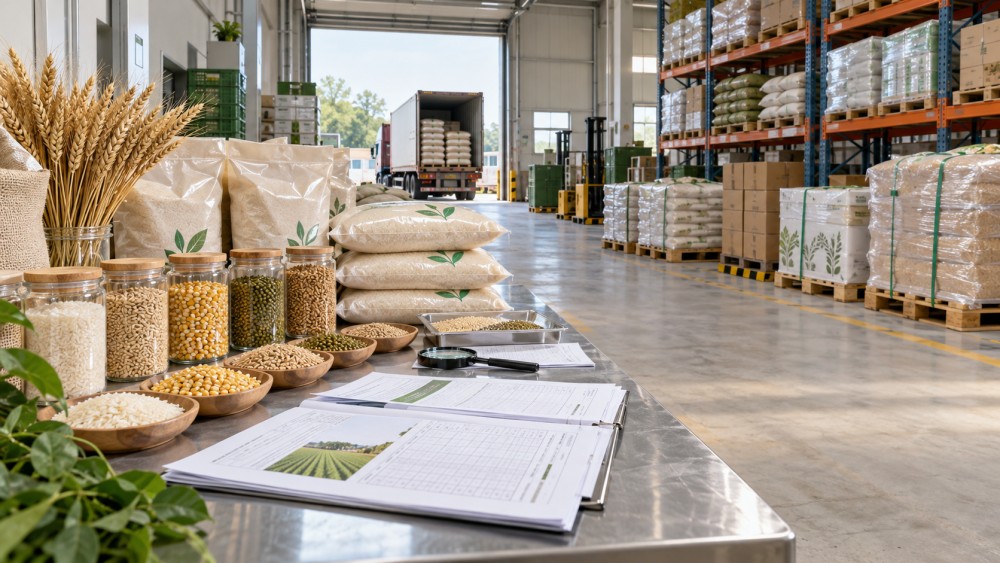
Mass-balance checks test whether recorded organic sales can be supported by purchases, production, inventory, and processing yields. For a mill, input grain and output flour cannot be compared without accounting for extraction rates, by-products, and losses. Traceability must demonstrate a plausible quantity flow, not just a collection of certificates.
Does organic certification replace food safety or quarantine approval?
No. Organic certification governs production and handling claims. It does not replace pesticide maximum residue limits, microbiological criteria, contaminant limits, phytosanitary requirements, veterinary controls, or general food import rules.
A certified organic product can still fail destination-country food safety requirements. Conversely, a residue test showing no detectable pesticides does not establish organic status: testing cannot prove the land’s conversion history, input use, or chain of custody.
Residue findings require assessment under the applicable organic rules. They can trigger investigation into prohibited use, drift, contamination, or failures in precautionary measures. The consequence is not identical in every jurisdiction, and a laboratory result should not be interpreted without considering the substance, circumstances, and regulatory requirements.
Standards such as GLOBALG.A.P., BRCGS, or food safety management certification may support buyer requirements, but they are not substitutes for organic certification.
Are livestock and fishery products covered by the same rules as crops?
No. Livestock standards address matters such as organic feed, animal origin, housing, outdoor access, veterinary treatment, and conversion periods. An organic crop certificate does not establish eligibility for milk, meat, eggs, or compound feed.
Animal-treatment rules illustrate why separate assessment matters. A treatment permitted under one system may affect organic eligibility differently under another. Necessary veterinary care must not be withheld to preserve a marketing claim; the animal’s subsequent organic status must follow the applicable standard.
Aquaculture is particularly market-specific. The EU has organic aquaculture rules, while the USDA NOP does not provide federal organic production standards for aquatic animals. Private certification therefore cannot be assumed to authorize a USDA organic claim for seafood. Wild-caught fish should not be confused with certified organic aquaculture.
What should be verified before a shipment is booked?
The essential review is shipment-specific rather than certificate-only. It should establish:
- Market eligibility: the destination rules, product category, and legal import route.
- Certification scope: valid status for the relevant operators, facilities, products, and activities.
- Label approval: permitted organic wording, logos, certifier details, and origin statements.
- Consignment documentation: required import certificates and consistency with invoices, lot numbers, quantities, and transport records.
- Physical integrity: segregation, packaging, cleaning, and any treatment required during transport or at entry.
Mandatory fumigation deserves advance attention because treatment with a prohibited substance can affect organic eligibility even when required for quarantine purposes. The resolution must be established before dispatch, not after the goods reach the border.
Authoritative checks should use the USDA National Organic Program, the European Commission’s organic trade guidance, Japan’s Ministry of Agriculture, Forestry and Fisheries, and the Canadian Food Inspection Agency, together with the responsible certifier and importer.
The decisive evidence is not how many organic logos appear on the packaging. It is whether the specific shipment has a valid certification route, an intact chain of custody, compliant labeling, and the required import documents.
Got questions about this industry topic or seeking best practices for your business? Drop us a line below, and let the expert team at AgriTrade help you out.
We respect your privacy. Your information is strictly confidential.
Related News
- 00
0000-00
2026 China–US Agricultural Trade Dialogue Held in Shanghai - 00
0000-00
USDA Reports Corn Sales to Mexico and South Korea, Soybean Sale to Unknown Destination - 00
0000-00
USDA Reports 120,000-Tonne Soybean Sale to Unknown Destinations on October 28 - 00
0000-00
Customs Data or Crop Forecasts: Which Tracks Soybean Export Supply? - 00
0000-00
Brazil’s Soybean Exports Surpass 105 Million Tonnes in 2026
0000-00
Export News Editorial Team
Weekly Insights
Stay ahead with our curated technology reports delivered every Monday.