Professional Agri-Forestry Industry Insights | Global Intelligence Leader

Do green bean exports to the U.S. need a phytosanitary certificate?





Green bean exports to the United States require a phytosanitary certificate when the applicable USDA Animal and Plant Health Inspection Service (APHIS) import conditions require one. There is no blanket answer covering every origin and product form. Fresh green beans must first be eligible for entry from the producing country, and any certificate, import permit, treatment, or additional declaration must match the conditions for that specific commodity–origin combination.
A phytosanitary certificate does not make an otherwise prohibited shipment admissible, and it does not establish compliance with U.S. food safety requirements. The practical starting point is to verify the current APHIS entry conditions before harvest and shipment, then address FDA requirements separately. A certificate arranged after dispatch cannot reliably resolve missing production controls, an unauthorized origin, or a treatment that should have occurred before export.
Define “green beans” before checking the requirement
For fresh vegetables, “green beans” generally means immature edible pods, commonly snap beans or string beans of Phaseolus vulgaris. However, commercial descriptions can conceal important differences. Yardlong beans belong to a different botanical classification, while “green beans” in the coffee trade means unroasted coffee. Those products should not be assessed using the same import entry.
The product specification used for the regulatory search should identify:
- The botanical name and commercial description.
- The plant part being shipped, such as fresh immature pods.
- The country where the crop was grown, not merely the country issuing the invoice.
- The processing condition: fresh, chilled, frozen, dried, canned, or otherwise prepared.
- The intended use and U.S. destination, including whether the shipment is destined for the continental United States or another U.S. jurisdiction.
Washing, trimming, or retail packing should not be treated as proof that a fresh product falls outside plant-health controls. Equally, requirements for fresh pods should not automatically be applied to commercially canned or frozen beans. Processing can change the applicable regulatory pathway, but the actual product condition must support that classification.
Routing a shipment through another country also does not erase its production origin. Re-export arrangements may require different documentation, and the relevant authorities must be able to establish the consignment’s identity and phytosanitary status.
The controlling answer comes from APHIS entry conditions
The principal official reference for checking plant-product import requirements is the APHIS Agricultural Commodity Import Requirements database (ACIR). Search using the precise commodity, country of origin, and applicable destination or use options. Read the complete conditions, including linked instructions and restrictions, rather than relying on a search-result heading.
The important distinction is between admissibility and documentation. Admissibility determines whether that product from that origin may enter under an established pathway. Documentation demonstrates that the shipment meets specified parts of that pathway. Obtaining a certificate from the exporting country does not substitute for U.S. authorization to import the commodity.
An APHIS import permit, where required, is a separate instrument from a phytosanitary certificate. The permit authorizes importation under stated conditions; the certificate provides official plant-health attestations from the exporting country. A shipment may require both, and neither should be treated as a replacement for the other.
Requirements can change in response to pest findings or regulatory action. Preserve the relevant ACIR conditions and permit instructions in the shipment file, with the date checked, and review them again before dispatch. An earlier successful shipment is useful operational history, not proof that the next consignment faces identical requirements.
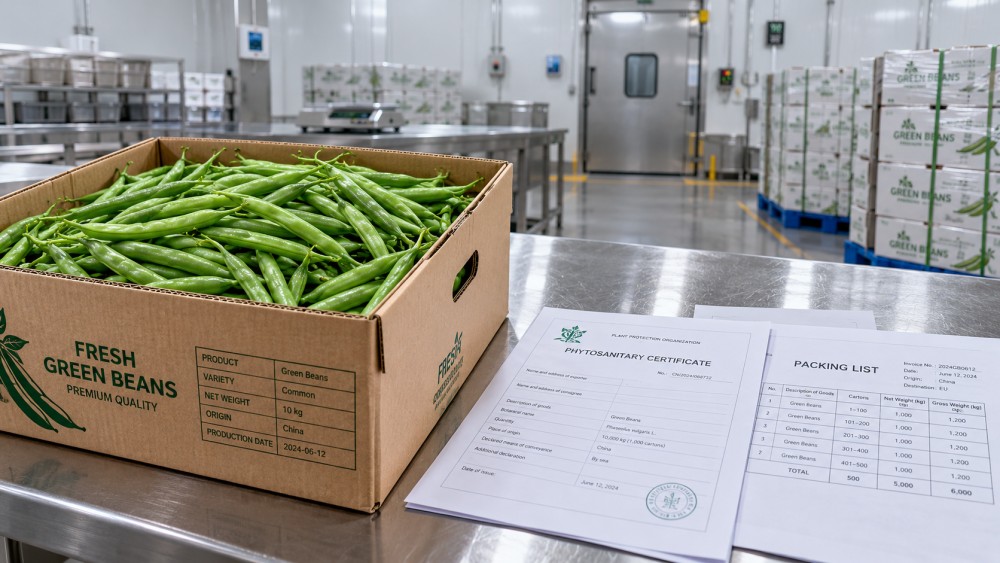
What a phytosanitary certificate actually establishes
A phytosanitary certificate is an official document issued by a national plant protection organization (NPPO), or under its authority, within the international framework established by the International Plant Protection Convention. It attests that the described consignment satisfies the importing country’s specified phytosanitary requirements.
It is not a private laboratory certificate, a supplier declaration, or a general assurance that the vegetables are safe to eat. Its scope concerns plant pests and related import conditions. Pesticide residues, human pathogens, and food facility hygiene require separate controls and evidence.
Where APHIS requires an additional declaration, the prescribed substance must appear correctly on the certificate. A generic statement such as “inspected and found healthy” may not satisfy a requirement addressing a particular pest, production area, or approved procedure. If the declaration depends on official field surveillance or a registered production site, a packing-house inspection alone cannot establish that condition.
The certificate must also describe the shipment accurately enough to connect it to the goods presented at entry. Check the commodity identity, botanical name, origin, quantity, package information, distinguishing marks, and any other required identifiers against the commercial and transport documents. Not every document uses identical fields, but discrepancies must not create uncertainty about which consignment was certified.
For re-exported goods, the appropriate documentation can depend on whether the consignment was stored, split, repacked, or exposed to pest risk in the intermediate country. The NPPO handling the re-export should determine the certification basis. A trader-issued certificate of origin does not perform this function.
Electronic phytosanitary certification should likewise be confirmed for the relevant route and official exchange arrangements. An emailed scan of a paper certificate is not automatically equivalent to an accepted electronic phytosanitary certificate.
Certification may depend on controls established before packing
The most consequential green bean export requirements may be operational rather than documentary. Depending on the applicable entry conditions, compliance could involve approved production locations, pest monitoring, packing-house controls, treatments, safeguarding, or official inspections. These measures are not universal requirements for every origin; they apply only where the relevant pathway specifies them.
This distinction matters when assessing export readiness. A company may be able to obtain an official inspection quickly but still lack the production records needed for a required declaration. If compliance depends on controls maintained throughout the growing period, the gap cannot be repaired by inspecting finished cartons.
Where a treatment is required, confirm the authorized treatment schedule and its operational conditions. The treatment must match the target commodity and applicable requirements; a process used successfully for another vegetable or destination is not sufficient evidence. If treatment at a particular location or facility is specified, a commercial agreement to treat elsewhere does not override that restriction.
Treatment feasibility also has a quality dimension. A legally acceptable process must be integrated with the product’s remaining shelf life and cold-chain plan. Routine refrigeration should not be represented as an approved quarantine treatment unless the applicable conditions expressly recognize the specified process.
After inspection or treatment, preserve the consignment’s identity and prevent reinfestation. Mixing certified lots with goods of uncertain status, changing packaging without authorization, or losing traceability between field, packing lot, and export consignment can undermine the basis on which certification was issued.
Plant-health clearance and FDA compliance are separate
APHIS plant-health requirements and U.S. Food and Drug Administration requirements address different risks. Satisfying one does not demonstrate compliance with the other, even when both are reviewed during the same import transaction.
Food facility registration deserves particular care because not every agricultural operation has the same status. Farms and certain other operations may qualify for exemptions, while activities at a separate packing or processing establishment can affect the analysis. The correct determination depends on the operation and activities, not simply on the fact that the shipment contains vegetables.
A phytosanitary certificate does not demonstrate that pesticide residues meet U.S. limits. Likewise, a satisfactory residue test does not establish freedom from quarantine pests. Private certifications such as GLOBALG.A.P. or a food safety management certification can support supplier assurance, but they do not replace government documents or mandatory entry conditions.
Build a release decision around evidence, not document presence
A pre-shipment file should establish a defensible link between the authorized import pathway and the actual consignment. Merely checking that a document titled “phytosanitary certificate” exists leaves the central questions unanswered: Is it required? Does it cover these goods? Does it contain the required attestations? Were the underlying controls completed?
Before loading, verify that:
- The botanical identity, origin, product condition, and destination match the regulatory determination.
- Any required import permit is valid and covers the proposed shipment.
- The NPPO can support and issue every required declaration.
- Required treatments and official controls are complete and properly recorded.
- Lot identities and quantities remain consistent across certification, packing, invoice, and transport records.
- The importer and broker have the necessary filing information and understand any port or inspection restrictions.
Keep commercial quality release distinct from regulatory release. Beans can meet size, appearance, temperature, and packaging specifications while remaining ineligible for entry. Conversely, complete plant-health documents do not establish that a lot has acceptable microbiological quality or remaining shelf life.
Certification also does not guarantee release at the U.S. border. Inspection can identify pests, contamination, documentary discrepancies, or failure to satisfy an entry condition. Depending on the finding and available regulatory options, a shipment may face treatment, re-export, or destruction. No business should assume that a missing pre-export measure can be corrected after arrival.
When the certificate requirement is unclear
Seek clarification using a complete product description, not the question “Do beans need a certificate?” Provide the botanical name, growing country, processing condition, destination, intended use, and proposed route, together with the ACIR entry or permit language causing uncertainty. APHIS can clarify U.S. import conditions; the exporting NPPO must confirm whether it can perform the required certification.
The shipment should remain on hold if admissibility is unresolved, a required declaration lacks supporting evidence, or a mandatory treatment cannot be completed as specified. For a perishable product, dispatching first and resolving the question later turns a regulatory uncertainty into an immediate cold-chain and disposal risk.
The reliable decision is therefore conditional but precise: obtain a phytosanitary certificate when the applicable APHIS pathway requires it, ensure that it accurately certifies the shipment and its required controls, and maintain a separate basis for FDA compliance. The deciding evidence is the current requirement for the actual commodity and origin—not a supplier’s customary paperwork or another shipment’s clearance history.
Got questions about this industry topic or seeking best practices for your business? Drop us a line below, and let the expert team at AgriTrade help you out.
We respect your privacy. Your information is strictly confidential.
Related News
- 00
0000-00
Three Keywords Behind the $650 Million in US-China Agricultural Deals - 00
0000-00
2026 China–US Agricultural Trade Dialogue Held in Shanghai - 00
0000-00
USDA Reports Corn Sales to Mexico and South Korea, Soybean Sale to Unknown Destination - 00
0000-00
USDA Reports 120,000-Tonne Soybean Sale to Unknown Destinations on October 28 - 00
0000-00
Customs Data or Crop Forecasts: Which Tracks Soybean Export Supply?
0000-00
Export News Editorial Team
Weekly Insights
Stay ahead with our curated technology reports delivered every Monday.