Professional Agri-Forestry Industry Insights | Global Intelligence Leader

Can plywood replace solid wood in compliant export packaging?





Plywood can replace solid wood in export packaging when the replacement satisfies both the applicable phytosanitary rules and the package’s mechanical requirements. It is a strong candidate for crate walls, lids, partitions, and suitably supported bases. Replacing runners, lifting members, or machinery anchorage blocks requires closer assessment because these components carry concentrated loads that a flat panel does not automatically accommodate.
Plywood manufactured through processes involving glue, heat, pressure, or a combination falls within the processed wood exemption under ISPM 15. However, a plywood crate with solid wood skids or internal blocking still contains components subject to the standard. Selecting compliant export wood materials therefore starts with the complete packaging assembly, including loose dunnage, and continues through structural validation and destination-specific requirements.
The exemption follows the material, not the crate’s name
ISPM 15 addresses phytosanitary risks associated with wood packaging material in international trade. Its processed wood exemption covers packaging made wholly from materials such as plywood whose manufacturing process addresses the relevant pest risk. A supplier description such as “plywood export crate” does not establish that every component qualifies.
The construction drawing and bill of materials provide a more reliable basis for assessment. Panel sides might be plywood while corner posts, battens, runners, and fastening blocks are sawn timber. Even small timber additions can change the compliance obligations. A last-minute brace fitted during loading belongs in the assessment just as much as a component installed during crate manufacture.
For regulated solid wood components, the applicable treatment, debarking, and marking requirements still apply. The exemption for the plywood panels does not extend to those components. An IPPC mark must be applied through an authorized system; it cannot be copied onto a package simply because treated timber was purchased. Assembly and marking arrangements need to remain consistent with the relevant national authorization procedures.
Destination acceptance also extends beyond ISPM 15. Packaging must arrive free of soil, pest contamination, and other prohibited material, while specific import conditions can impose additional obligations. Establish the destination’s current requirements using the relevant plant protection authority’s guidance. A claim that plywood is “export approved” without identifying the material construction and applicable requirements is insufficient evidence.
Identify which parts actually carry the load
A crate’s external appearance reveals little about its load path. In a machinery package, equipment weight may pass through mounting feet into bearers, then through runners to the floor or forklift tines. The plywood walls could mainly provide enclosure and lateral restraint. Replacing those walls is a different engineering change from removing the bearers.
Cross-laminated veneers give plywood useful panel properties, but the finished product still has directional characteristics. Strength and stiffness depend on veneer species, layup, grade, thickness, and face-grain orientation. Two panels of equal nominal thickness can behave differently under the same loading. Thickness alone is therefore an incomplete substitution specification.
The following distinctions help determine where replacement is straightforward and where redesign is necessary.
Consider a machine standing on narrow steel feet. A plywood floor could remain satisfactory under a distributed test load yet suffer local indentation or punching beneath those feet. A bearing plate spreads contact pressure, while a bearer directly below the mounting position transfers the force into the base structure. These changes solve different problems and should not be treated as interchangeable reinforcement.
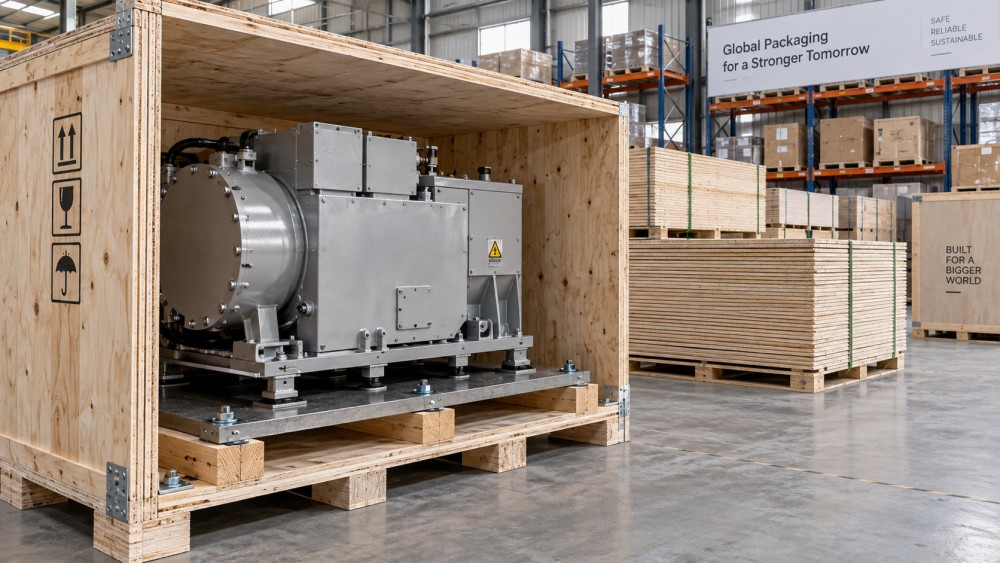
Similarly, a stiff lid does not establish stacking capacity. Stacking loads need a continuous route through the package to its supports. If the upper crate bears near unsupported lid edges, the resulting deformation can damage the enclosure even when the base safely carries the product itself.
Panel grade matters more than a generic “export plywood” label
A usable specification identifies the panel’s intended structural role, nominal thickness and tolerance, veneer construction, bond classification, and relevant strength data. Terms such as “commercial plywood” or “export quality” leave too much unresolved. Decorative appearance, a smooth face, and a stated adhesive type do not establish load-bearing suitability.
Core gaps and overlaps deserve attention where screws, bolts, or concentrated loads occur. A void beneath a fastening position reduces the wood available to engage the fastener; a discontinuity near a loaded support can weaken local behavior. Face quality alone does not reveal the internal construction. Product documentation and representative inspection should address the defects relevant to the proposed use.
Panel orientation belongs on the cutting and assembly drawings. Nesting parts to minimize sheet waste can rotate a load-bearing panel away from its intended direction. Where design properties differ by direction, this apparently minor production change alters the package’s stiffness and strength.
Built-up plywood runners require their own specification. Layer thickness, grain arrangement, bonding, mechanical fastening, and splice location all influence performance. Stacking strips until they resemble the dimensions of a timber runner does not establish equivalent behavior. Any adhesive connection needs a defined manufacturing process and performance appropriate to the expected exposure.
Moisture changes the comparison
A bond suitable for wet exposure helps plywood resist delamination, but it does not make the wood waterproof. Veneers still absorb moisture, especially through exposed edges and drilled holes. Moisture uptake changes dimensions and mechanical behavior, and repeated wetting can damage a package that performed adequately in dry storage.
The exposure scenario should distinguish sheltered transport from outdoor loading, rain exposure, and condensation inside a container. Packaging around chilled goods encounters different moisture conditions from a machinery crate stored under cover. Duration also matters: brief wetting followed by drying differs from sustained dampness under load.
Edge sealing, protected joints, and appropriate covers reduce water entry. Their benefit depends on application quality and damage during handling. Forklift contact, field drilling, and abrasion can break a coating at precisely the locations carrying the highest loads. Drainage and avoidance of water traps remain important even when surfaces are coated.
A moisture barrier around the product serves a separate function from weather protection for the crate. An impermeable wrap can trap moisture if timber, plywood, or the product enters the package wet. Condensation inside a sealed enclosure cannot be resolved by specifying a more durable panel bond alone. Packaging closure conditions, barrier integrity, and any humidity-control provisions need to work together.
Connections can determine whether replacement succeeds
Changing solid boards to plywood changes the fastening substrate. A screw driven into a panel face engages a different arrangement of veneers from one driven into the panel edge. Edge connections can be vulnerable to splitting or separation between layers, particularly with poor positioning or excessive tightening.
Joint design should define fastener type, embedment, spacing, edge distances, and the members being connected. Dense fastener spacing does not necessarily improve a joint: closely grouped holes can weaken the surrounding material. Assembly accuracy matters because a missed support leaves a fastener attached only to the panel.
Through-bolts with suitably sized washers or backing plates distribute forces over a larger area. Their effectiveness still depends on local panel bearing strength, hole placement, and tightening. Excessive clamping can crush the panel, while inadequate restraint allows movement under vibration. Heavy machinery anchorage needs a demonstrated connection into the base structure, rather than attachment to an unsupported sheet.
Diagonal distortion during handling is another useful comparison. A plywood wall can provide effective bracing when its perimeter connections transfer shear into the frame. If those joints are weak, the panel’s own strength contributes little to resistance against racking. Removing timber braces therefore requires assessment of the assembled crate, including its joints.
Validate the package against its actual handling conditions
Replacement approval should use an agreed loading and handling profile. Product mass alone leaves out forklift support positions, lifting arrangements, stacking, restraint forces, and foreseeable impacts. The center of gravity affects reactions at the supports; an offset machine can overload one side of a base even when the total weight remains unchanged.
A static loading test demonstrates only the conditions it reproduces. A crate resting across its full base has a different support condition from the same crate carried on two forklift tines. Long-duration stacking also introduces deformation over time, especially in humid conditions. Validation should represent the critical support geometry and environmental exposure.
Useful acceptance criteria describe observable failure and acceptable movement: excessive floor deflection, crushed bearing zones, loosened fastenings, panel separation, or product displacement. Limits should reflect the product’s sensitivity and handling requirements. There is no universal plywood thickness that establishes safe packaging for every load.
After a handling trial, inspect concealed interfaces as well as visible surfaces. Damage beneath mounting feet, around bolt holes, and at runner-to-deck joints can develop before an external panel shows obvious distress. Where the package includes a sealed product enclosure, the trial also needs to establish that movement has not punctured or abraded the barrier.
Make the approved construction reproducible
A plywood replacement becomes useful only when the approved design can be reproduced in production. The material description, component drawing, fastening schedule, and permitted substitutions should agree. Replacing a specified panel with a visually similar sheet changes the evidence supporting the design unless the relevant properties remain equivalent.
For mixed-material packaging, records should distinguish exempt processed wood from regulated solid wood and connect the latter to the applicable treatment and marking arrangements. A treatment document supports traceability but does not replace the required mark where that mark is mandatory. Loose blocking added at dispatch needs the same material control as the original package.
A practical approval record can remain compact:
- The final assembly drawing identifies load-bearing panels, supports, fastenings, lifting locations, and any solid wood components.
- Material evidence establishes the specified panel construction and properties. Where a substitution is allowed, its limits are explicit.
- Structural calculations or representative trials cover the critical load cases, with recorded acceptance criteria and results.
- Destination requirements and the treatment and marking basis are recorded for the actual packaging configuration.
Full plywood construction is a sound option when engineered supports and connections carry the shipment loads and the exposure conditions suit the specified panels. A mixed design remains appropriate when treated solid wood provides a better runner or anchorage arrangement. If a repair introduces solid wood into a previously all-plywood package, reopen the phytosanitary assessment before dispatch; if it changes a lifting member or load-bearing joint, reopen the structural assessment as well.
Got questions about this industry topic or seeking best practices for your business? Drop us a line below, and let the expert team at AgriTrade help you out.
We respect your privacy. Your information is strictly confidential.
Related News
- 00
0000-00
Three Keywords Behind the $650 Million in US-China Agricultural Deals - 00
0000-00
2026 China–US Agricultural Trade Dialogue Held in Shanghai - 00
0000-00
USDA Reports Corn Sales to Mexico and South Korea, Soybean Sale to Unknown Destination - 00
0000-00
USDA Reports 120,000-Tonne Soybean Sale to Unknown Destinations on October 28 - 00
0000-00
Customs Data or Crop Forecasts: Which Tracks Soybean Export Supply?
0000-00
Export News Editorial Team
Weekly Insights
Stay ahead with our curated technology reports delivered every Monday.