Professional Agri-Forestry Industry Insights | Global Intelligence Leader

Husbandry Industry Outlook: Feed Costs, Labor Gaps, and Farm Margins





A livestock business can face tighter margins even when feed quotations ease: older inventory may still carry higher costs, overtime may be rising, and slower animal growth may delay sales. Across the husbandry industry, feed costs and labor gaps need to be assessed together because both affect the cost of producing a saleable unit, not just the monthly expense total.
The practical outlook is conditional rather than uniformly positive or negative. Margin recovery depends on whether lower delivered feed costs reach the ration, staffing supports consistent animal performance, and selling prices hold through the production cycle. Before expanding capacity or committing to long contracts, decision-makers should test those three conditions against their own operating data.
Feed price relief does not automatically become margin relief
Grain and protein meal quotations provide useful market signals, but they are not the same as farm-level feed costs. Freight, currency exposure, processing charges, ingredient quality, and existing purchase commitments can keep delivered costs elevated after benchmark prices decline. Conversely, a farm with favorable contracted supply may remain temporarily insulated from a market increase.
This timing difference matters when interpreting financial performance. Purchasing records show what entered inventory; feed-use records show what animals consumed. Comparing this month’s livestock revenue with this month’s ingredient purchases can distort the underlying margin when inventory changes substantially. Management accounts should connect consumed feed costs to the relevant herd, flock, or production batch wherever practical.
Procurement decisions also need a nutritional denominator. A cheaper ingredient is not necessarily cheaper after adjustments for moisture, usable energy, digestibility, transport, and storage losses. Reformulation that reduces ration cost but worsens feed conversion, milk output, egg production, or animal health can increase cost per saleable unit.
Separate the market signal from the purchasing decision
A useful feed review follows three connected questions:
- What is moving the delivered price? Separate commodity movements from freight, exchange rates, supplier premiums, and local availability.
- What exposure remains open? Map contracted quantities, usable inventory, expected consumption, and delivery dates rather than relying on an average purchase price.
- What happens to production? Assess ingredient substitutions with a qualified nutritionist, including quality limits and any effect on intake, output, or manure characteristics.
Layered purchasing can reduce dependence on a single buying date, but it is not automatically the cheapest approach. Longer commitments protect availability and budget visibility while limiting participation in later price declines. Spot buying preserves flexibility but increases exposure to local shortages. The appropriate balance depends on working capital, storage conditions, supplier reliability, and how confidently future consumption can be forecast.
Labor gaps become production losses before they appear in payroll
An unfilled position is visible. Missed heat detection, delayed treatment, inconsistent feeding, and unfinished maintenance are less visible, yet they can carry greater economic consequences. A farm may report stable labor expenditure while productivity deteriorates because the remaining team cannot complete time-sensitive work reliably.
The first distinction is between insufficient headcount and poor deployment. Repeated overtime may reflect vacancies, but it can also arise from equipment downtime, awkward animal movement, duplicated records, or work schedules that do not match peak demand. Adding workers without identifying the bottleneck can increase costs while leaving the underlying constraint untouched.
Review tasks by their production consequences. Feeding, water access, welfare checks, milking routines, and disease detection have different timing requirements from general yard work. Protect critical routines first, then examine whether lower-priority work can be rescheduled, simplified, or contracted out without creating biosecurity or quality risks.
Measure labor efficiency alongside biological performance. Hours per saleable unit are useful, but a falling ratio is not an improvement if mortality, injuries, treatment delays, or product rejection increase. Pair labor measures with output, animal health, staff turnover, and task-completion records to distinguish genuine efficiency from deferred work.
Retention decisions belong in the same calculation. Training time, supervision, recruitment expense, and production disruption can make repeated turnover expensive even when the advertised wage remains competitive. Clear responsibilities, predictable scheduling where feasible, and documented routines address operational weaknesses that recruitment alone cannot fix.
Build the margin view around the production system
A single livestock price or feed benchmark cannot describe the outlook for every enterprise. Purchased-feed exposure, biological lead times, and the ability to change output differ sharply between species and business models. Even neighboring farms can experience different margin movements because of contract terms, debt obligations, forage quality, or market access.
Integrated operators need an additional distinction between internal transfer prices and group economics. A livestock unit can appear profitable because feed or processing costs sit elsewhere in the business. Decisions about expansion should use consistent transfer assumptions and also test the consolidated margin.
Use a margin bridge instead of a broad cost-cutting target
When profitability weakens, a general instruction to reduce expenditure can cut productive inputs alongside waste. A margin bridge is more useful: explain the movement from the previous period to the current period through selling price, saleable volume, feed price, feed efficiency, labor, animal health, energy, and financing costs.
Separate price effects from usage effects. Higher feed expenditure may come from a more expensive ration, greater animal numbers, poorer conversion, or excess wastage. Each requires a different response. Likewise, higher labor costs may be justified by additional saleable output, while unchanged payroll can conceal deteriorating service levels.
Use consistent denominators and production stages. Feed cost per animal is difficult to interpret if animal weights or days on farm have changed. Cost per kilogram of liveweight gain, kilogram of saleable product, or another system-appropriate output measure is usually more informative. Record whether the calculation includes replacements, mortality losses, and unsaleable output.
Contribution margin and full economic margin answer different questions. Revenue less defined variable costs can help with short-term operating choices, but it does not establish whether the business covers depreciation, finance, owner labor, and invested capital. Both views are needed before treating a temporary operating surplus as evidence that expansion is affordable.
Which market signals deserve management attention?
Industry news is most useful when it changes an operating assumption. A distant grain-market development may have little immediate effect on a protected local supply contract. A nearby feed-mill interruption or processor scheduling change may matter much more. Monitoring should therefore connect external signals to the farm’s actual exposure.
- Feed availability and delivered quotations: Track relevant ingredients, supplier lead times, freight, and quality adjustments. A lower benchmark with widening local premiums is not clear evidence of relief.
- Forward livestock or product values: Compare expected receipts with costs over the same production window. Check contract deductions, quality conditions, and delivery requirements.
- Labor capacity: Follow overtime, vacancy duration, turnover, missed routines, and absence coverage. Payroll alone will not reveal the operational gap.
- Biological performance: Review feed conversion, growth, reproduction, mortality, and rejection rates against the farm’s own comparable periods.
- Cash and credit exposure: Monitor inventory commitments, payment timing, borrowing costs, and available headroom. Positive accounting margins can coexist with a cash shortage.
Weather, animal disease restrictions, and trade-policy changes deserve attention where they affect these measures. Verify operational or regulatory implications with the relevant authority or contract counterparty before changing animal movements, sourcing arrangements, or delivery commitments. A general market headline is not sufficient evidence of a farm-specific obligation.
Test the next production commitment under three conditions
A single forecast can hide how quickly a viable plan becomes strained. Before adding animals, renewing a major supply agreement, or approving equipment, prepare a base case, a favorable case, and a downside case using assumptions relevant to the operation. These are planning scenarios, not market predictions.
The downside should combine plausible pressures rather than changing only one input: higher delivered feed costs, weaker sale prices, and a staffing disruption that affects output. Biological production cannot always be reduced quickly, so include the cash required to finish existing animals or maintain the herd through the adjustment period.
Then identify the decision threshold. How much can the selling price fall before the planned batch fails to cover its defined costs? At what feed cost does additional finishing become unattractive? How long can a vacancy persist before welfare, throughput, or maintenance becomes unacceptable? Thresholds turn an outlook into an operating decision.
Contract structure matters as much as the forecast. Securing feed while leaving all output prices exposed creates a different risk from matching input commitments with reasonably predictable sales. Matching will rarely be exact because quantities, quality, and delivery timing vary. Any hedging instrument also requires an understanding of basis risk, liquidity needs, and contractual obligations.
Approve automation against the actual bottleneck
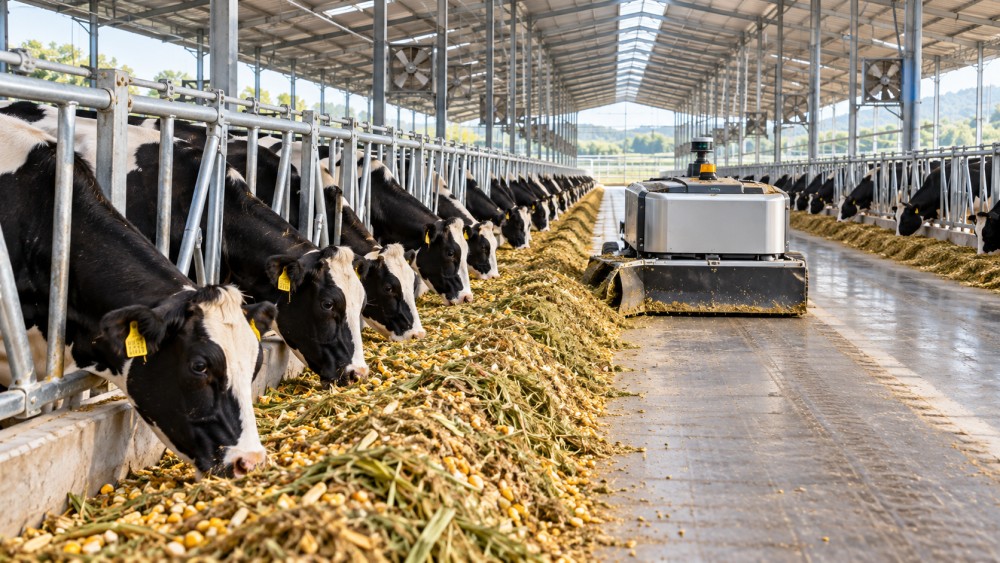
Labor shortages can strengthen the case for automated feeding, monitoring, handling, or milking, but advertised labor savings are not enough. Compare the installed cost with achievable reductions in paid hours, avoided losses, and additional usable capacity. Include maintenance, training, utilities, service availability, and downtime cover.
A system that frees staff time may still be worthwhile without reducing headcount if it restores neglected health checks or removes a throughput constraint. Make that benefit explicit rather than counting it as a payroll saving. Test whether buildings, animal flow, connectivity, and team skills support the equipment before committing capital.
Set operating triggers before expanding
The more defensible husbandry industry outlook is a range of possible margins shaped by local exposure and execution, not a single direction for farm profitability. Lower feed costs offer an opportunity, but only where purchasing terms and animal performance allow the benefit to reach the business. Labor availability determines whether that opportunity can be sustained.
Expansion should therefore have operating gates: feed coverage aligned with expected consumption, dependable staffing for critical routines, acceptable downside cash requirements, and a realistic sales channel. Where one gate remains unresolved, a smaller commitment or delayed placement may preserve flexibility better than adding capacity that the current workforce and balance sheet cannot reliably support.
Got questions about this industry topic or seeking best practices for your business? Drop us a line below, and let the expert team at AgriTrade help you out.
We respect your privacy. Your information is strictly confidential.
Related News
- 00
0000-00
Particle Board Industry Outlook: Demand Drivers and Raw Material Risks - 00
0000-00
Agro-Processing Industry Analysis: Supply Chain Risks and Growth Opportunities - 00
0000-00
Global Food Ingredient Market Size: Growth Drivers and Key Segments - 00
0000-00
Food Ingredient Market Forecast: Key Growth Drivers and Emerging Opportunities - 00
0000-00
Listed Agriculture Company Earnings Updates: What Margins and Guidance Reveal
0000-00
Industry Insights Editorial Team
Weekly Insights
Stay ahead with our curated technology reports delivered every Monday.